Royal Opera House, London
Running time: 2hr 45mins (inc. two intervals)
Age Restrictions: This production is recommended for ages 14+.
Tickets from £53.00
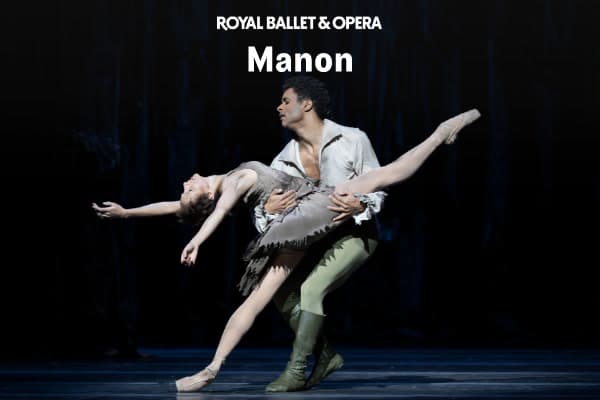
In the seedy underbelly of 18th-century Paris, money is king. Nothing is sacred – even love itself can be bought for the right price. A native of this hedonistic underworld, Manon is caught between twin desires when she falls in love with the student Des Grieux. Steadfast and devoted, he offers the possibility of an honourable life – but the riches promised by the world of Parisian society remain tempting...
ACT I
Actresses, gentlemen and the demi-monde from Paris gather at the courtyard of an inn near Paris. Among them are Des Grieux (a young student), the wealthy Monsieur G.M. and Lescaut, who is there to meet his sister Manon on her way to enter a convent. During the hustle and bustle of arrivals and introductions, a beggar steals a watch from Monsieur G.M. and celebrates gleefully before its loss is discovered and Lescaut has to intervene to save him from punishment. Soon afterwards, Manon arrives with an Old Gentleman who is obviously attracted to her. Lescaut notices the Old Gentleman’s interest and takes him into the inn to come to an arrangement over Manon. Manon remains outside and meets Des Grieux. He is entranced by her. They fall in love and decide to escape to Paris with the help of the money that she has stolen from the Old Gentleman. Lescaut and the Old Gentleman come out of the inn, having made a bargain, and to their dismay see that Manon has disappeared. Monsieur G.M. tells Lescaut that he too is interested in Manon and, because of G.M.’s wealth, Lescaut promises to find Manon and persuade her to accept him.
Des Grieux and Manon are at his lodgings in Paris. He is writing a letter to his father. Manon interrupts by declaring her love for him. Des Grieux goes to post the letter and in his absence Lescaut arrives with Monsieur G.M.. Manon quickly yields to G.M.’s advances. When Des Grieux returns, Lescaut persuades him that there will be great wealth for all of them if he will sanction the liaison between G.M. and Manon.
ACT II
Manon arrives at the party given by Monsieur G.M. at Madame’s hôtel particulier. She is clearly torn between the wealth of her companion and her love for Des Grieux, who is there with Lescaut. Des Grieux tries to persuade Manon to leave with him but she tells him that the time is not right and will be only when he takes more of Monsieur G.M.’s money at cards. Des Grieux is caught cheating and he and Manon rush away. Back in Des Grieux’s lodgings, he and Manon once again declare their love. Monsieur G.M. arrives with the police and Manon is arrested as a prostitute. In the ensuing struggle, Lescaut is killed.
ACT III
The Gaoler of the penal colony awaits the arrival of the convicts from France at the port.
Manon has been deported to America as a prostitute and Des Grieux has followed her there by pretending to be her husband. The Gaoler sees them together and turns his interest towards Manon.
The Gaoler has arrested Manon but takes her to his room and offers her rewards in the hope that she will desert Des Grieux and live with him. Des Grieux breaks in and kills the Gaoler.
Manon has escaped with Des Grieux into the swamp of Louisiana to elude their pursuers. All her former ambitions of wealth and splendour have been renounced for her love of Des Grieux. Manon collapses and dies in Des Grieux’s arms.
Royal Opera House
Royal Opera House
Bow Street
London
WC2E 9DD
The Royal Opera House is an opera house and major performing arts venue in the London district of Covent Garden. The large building is often referred to as simply "Covent Garden", after a previous use of the site of the opera house's original construction in 1732. It is the home of The Royal Opera, The Royal Ballet and the Orchestra of the Royal Opera House. Originally called the Theatre Royal, it served primarily as a playhouse for the first hundred years of its history. In 1734, the first ballet was presented. A year later Handel's first season of operas began. Many of his operas and oratorios were specifically written for Covent Garden and had their premieres there.
The current building is the third theatre on the site following disastrous fires in 1808 and 1857. The façade, foyer and auditorium date from 1858, but almost every other element of the present complex dates from an extensive reconstruction in the 1990s. The Royal Opera House seats 2,268 people and consists of four tiers of boxes and balconies and the amphitheatre gallery. The proscenium is 12.20 m wide and 14.80 m high. The main auditorium is a Grade 1 listed building.
Travel by train: Charing Cross. Nearest tube: Covent Garden

